





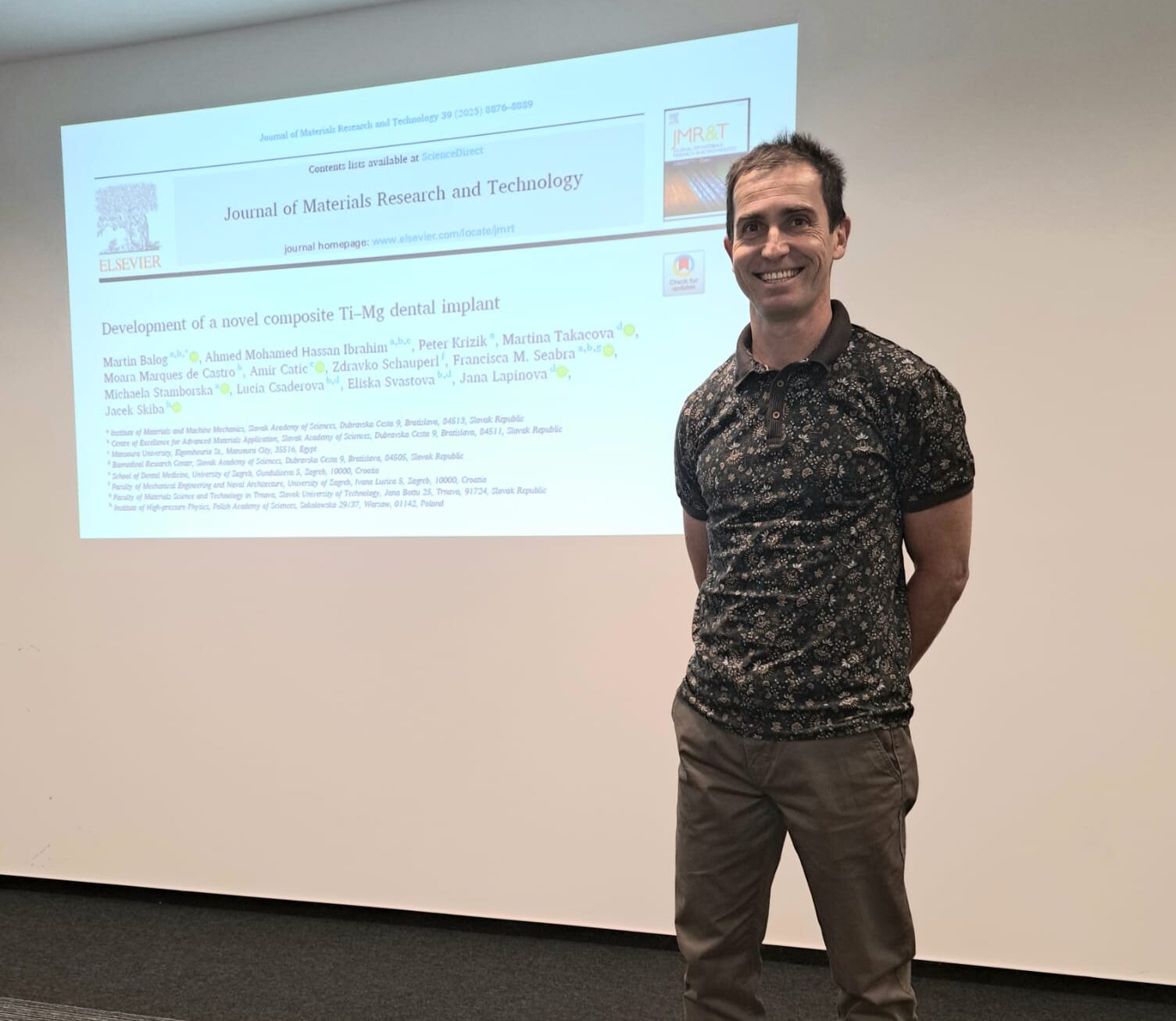
How can the combination of titanium and magnesium contribute to the development of new dental implants? The answer was provided by the publication seminar of the Institute of Materials and Machine Mechanics of the Slovak Academy of Sciences, which presented current scientific results in this area.
On Wednesday, April 22, 2026, a publication seminar was held in the large conference room of the Institute of Materials and Machine Mechanics of the Slovak Academy of Sciences, at which Ing. Martin Balog, DrSc. presented his latest scientific publication “Development of a novel composite Ti–Mg dental implant”.
The seminar presented current research of the Institute of Materials and Machine Mechanics of the Slovak Academy of Sciences – Composite Dental Implant. The research focuses on the development of the composite material Ti17Mg, which consists of a titanium matrix and a network of bioresorbable magnesium fibers. This approach allows combining the mechanical stability of titanium with the biological properties of magnesium.
One of the key results is a reduction in the elastic modulus by approximately 20% compared to pure titanium, which means that the material’s properties are closer to human bone and can contribute to reducing the so-called stress-shielding effect. The mechanical, corrosion and biological properties of the implant were evaluated as part of the research. The results show that the designed implant meets the requirements for mechanical resistance and fatigue life for a given type of application.
Biological tests also indicate the material’s potential to support bone tissue formation and improve the interaction between the implant and bone. However, these results are based on laboratory tests and their confirmation in clinical practice requires further research.
The presented work was published in the Journal of Materials Research and Technology (Open Access, 2025) and was created in collaboration with an international team of authors.
The seminar provided space for professional discussion on further research directions, including ongoing preclinical tests to verify the material’s behavior in conditions close to real use.